PSU Tier List 2026: Every Power Supply Ranked (S to D)
Last updated: October 2026
Quick answer: The best power supplies in 2026 sit in Tier S — units like the Seasonic Prime TX/PX, Corsair AXi series and be quiet! Dark Power Pro 13, built on top-tier platforms with 10–12 year warranties. Tier A (Corsair RMx, Seasonic Focus GX, MSI MPG A-GF) is the sweet spot for most gaming PCs. Below you'll find the full S-to-D ranking plus a wattage guide.
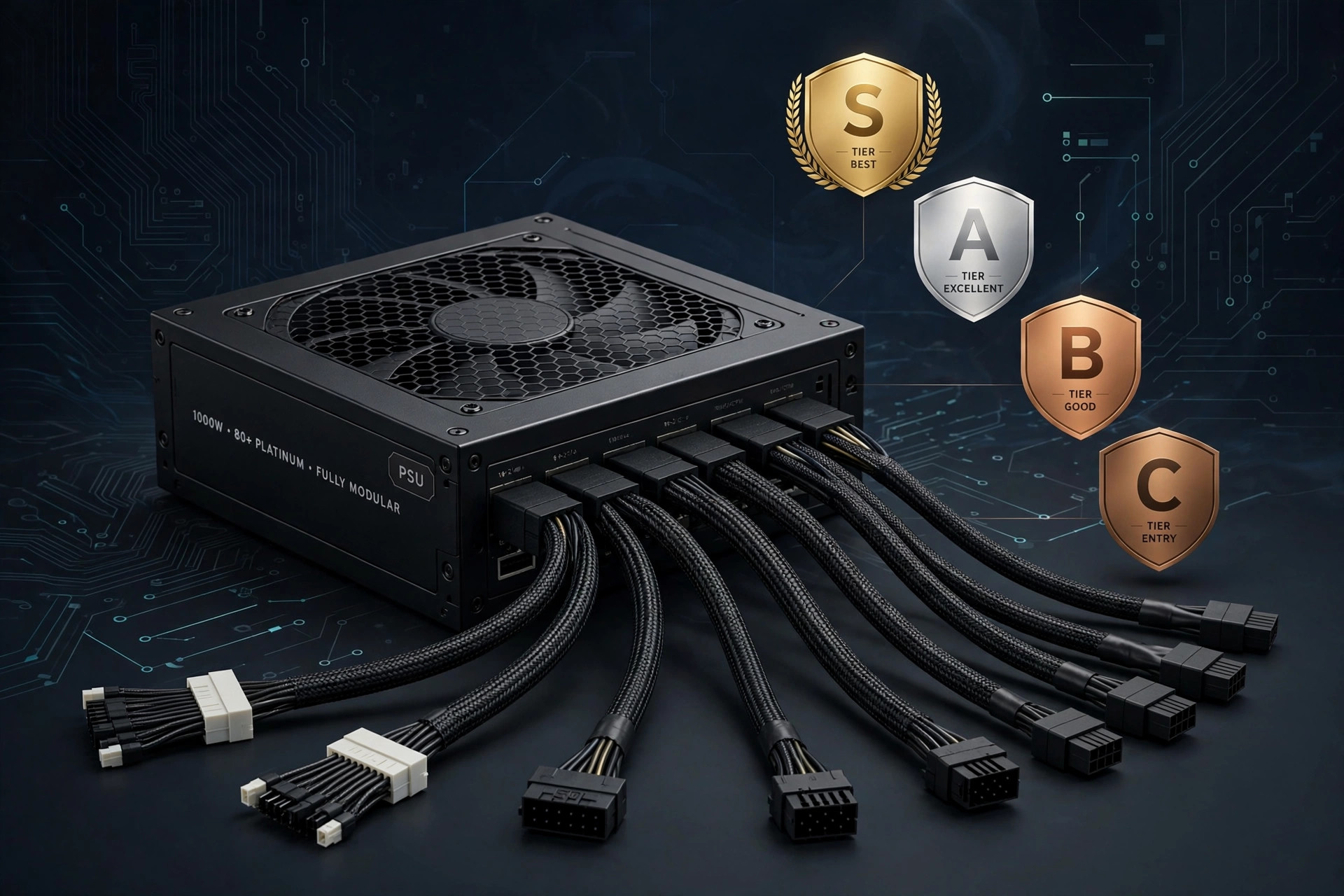
By PC Bottleneck Calculator · Reviewed October 2026 · Our methodology
How to use this tier list
A power supply is the one component that can take the rest of your PC with it if it fails. This list ranks PSUs by platform quality — the internal design, components and protections — compiled from professional reviews (Cybenetics, Tom's Hardware, TechPowerUp), not from marketing or paid placement. Within a tier, any unit is a defensible buy; across tiers, higher is objectively better built.
Two things matter more than the tier letter: buying enough wattage (see the guide below) and buying a current revision — manufacturers silently revise platforms, so check the exact model year.
PSU wattage guide: how much power do you need?
Match your graphics card first; the CPU and the rest of the system typically add 150–250W on top.
| Graphics card | Recommended PSU wattage |
|---|---|
| RTX 4060, RX 7600, Arc B580 | 550W |
| RTX 4060 Ti, RTX 3060 Ti, RX 7700 XT | 600W |
| RTX 4070, RX 7800 XT | 650W |
| RTX 4070 Super / Ti, RX 7900 XT | 750W |
| RTX 4080 / Super, RX 7900 XTX | 850W |
| RTX 4090 | 1000W |
| RTX 5090 | 1200W |
When in doubt, go one step up — a PSU runs quietest and most efficiently at 40–60% load, and headroom covers transient power spikes from modern GPUs. If you're pairing parts, our bottleneck calculator will also flag when your GPU choice implies a bigger PSU than you planned.
Tier S — the best of the best
Reference-grade units: best-in-class voltage regulation, all-Japanese capacitors, 10–12 year warranties, and top Cybenetics ETA/LAMBDA ratings. Buy these when the budget allows and never think about your PSU again.
| Series | Wattages | Warranty |
|---|---|---|
| Seasonic Prime TX / PX | 650–2200W | 12 years |
| Corsair AXi (AX1600i) | 1600W | 10 years |
| be quiet! Dark Power Pro 13 | 750–1600W | 10 years |
Our analysis
Tier S exists for people who keep a PSU through two or three full builds. The Seasonic Prime platform in particular has been the reviewer's reference for years — ripple suppression and transient response that cheaper units can't touch. You pay a premium of roughly $40–80 over Tier A for measurably better internals and a longer warranty.
Tier A — the sweet spot for gaming PCs
Excellent platforms with full protections, quiet operation and 7–10 year warranties. This is where the vast majority of gaming builds should land — Tier S performance at sane prices.
| Series | Wattages | Warranty |
|---|---|---|
| Corsair RMx / RM (2021+) | 550–1200W | 10 years |
| Seasonic Focus GX / Vertex GX | 550–1200W | 10 years |
| MSI MPG A-GF / A-GX | 650–1000W | 10 years |
| EVGA SuperNOVA G6 / G7 / P6 | 650–1000W | 7–10 years |
| be quiet! Straight Power 12 | 750–1200W | 10 years |
| Thermaltake Toughpower GF3 / GF A3 | 750–1650W | 10 years |
Our analysis
The Corsair RMx and Seasonic Focus GX lines are the default recommendations for a reason: consistently strong reviews across every revision, ATX 3.x options with native 12V-2x6 cables on newer models, and warranties that outlast the rest of the build. If your build needs 750W or less, start here and stop worrying.
Tier B — good budget options
Solid platforms with minor compromises — slightly louder fans, shorter warranties (5 years typical), or older designs. Fine for mid-range builds where every dollar counts.
| Series | Notes |
|---|---|
| Corsair CX-M (2021, grey label) | Best budget pick; avoid the old green-label version |
| EVGA SuperNOVA G5 | Good regulation, louder fan curve |
| Thermaltake Toughpower GF1 | Strong value at 650–850W |
| MSI MAG A-BN | Basic but honest bronze unit |
Our analysis
Tier B is perfectly safe — these are not "bad" PSUs, they're just not exceptional. The 2021 Corsair CX-M is the standout: a genuinely good budget platform that regularly sells under $70. The main thing you give up versus Tier A is warranty length and some acoustic refinement.
Tier C — acceptable only for basic builds
Functional units for office PCs and very light gaming builds. Group-regulated or basic DC-DC designs, 3–5 year warranties. Don't pair these with a $500+ graphics card.
| Series | Notes |
|---|---|
| EVGA BQ | Semi-modular, fine for iGPU/GTX 1650-class builds |
| Corsair CV | Budget bronze; acceptable at 450–550W for basic systems |
Tier D — avoid
Generic or no-name units, inflated wattage claims, missing protections, fake or absent 80 Plus certification. A Tier D PSU can work for years — until the day it doesn't, and takes your motherboard with it. There is no build cheap enough to justify one.
What actually makes a PSU good
- Protections: OCP, OVP, OPP, SCP and OTP should all be present and functional. Every Tier S–B unit above has them.
- Efficiency ratings: 80 Plus Gold or better is the modern baseline for gaming. Cybenetics ETA/LAMBDA ratings are stricter and worth checking when available.
- ATX 3.x and 12V-2x6: Required for RTX 40/50-series cards at high wattages. Older PSUs can work with adapters, but native support is cleaner and safer.
- Warranty length: The best proxy for manufacturer confidence. 10 years (Tier S/A) vs 3 years (Tier C) tells you everything.
- Fan and noise: Reviewed LAMBDA ratings (A++ to Standard) tell you how loud a unit gets under load — worth checking for bedroom PCs.
How we rank: what reviewers actually test
Tier lists aren't vibes — they're downstream of measurable engineering. When professional reviewers (Cybenetics, Tom's Hardware, TechPowerUp) evaluate a PSU, these are the tests that separate Tier S from Tier C:
- Voltage regulation: how tightly the 12V rail holds under load swings. Top units stay within 1%; mediocre ones drift past 3%.
- Ripple suppression: leftover AC noise on the DC output, measured in millivolts. Less is better — high ripple stresses VRMs on your motherboard and GPU over time.
- Transient response: how fast the PSU reacts when a GPU suddenly spikes from 100W to 400W and back. This is the test that kills cheap units and the reason ATX 3.x exists.
- Hold-up time: how long the PSU keeps delivering power after input loss (17ms+ is the ATX spec). Matters for brownouts, not blackouts.
- Protections that actually trip: reviewers deliberately fault units to confirm OCP/OVP/SCP engage. Some budget units have the protection chips but misconfigured thresholds — functionally unprotected.
You don't need to memorize any of this. The tier list above is the compressed output of hundreds of those tests. But knowing what's tested explains why two 750W Gold units can be tiers apart: same sticker, different engineering.
A better PSU never fixes a bottleneck — identify your real performance limit before upgrading anything.
Sources & further reading
- Seasonic official site — Power supply specifications and platform information.
- Corsair official site — PSU specifications and product documentation.
- Cybenetics — Independent power supply efficiency and noise certifications.
Frequently Asked Questions
Is 750W enough for an RTX 4070?
Yes. An RTX 4070 build typically draws 400–450W under full gaming load, so a quality 650W unit is sufficient and 750W gives comfortable headroom. Check the wattage guide above for other cards.
Does 80 Plus Gold vs Platinum matter?
For your electricity bill, barely — the difference is 2–3% efficiency at typical loads. Platinum units usually correlate with better overall platforms, but buy the tier, not the sticker.
Are ATX 3.0 PSUs required for new GPUs?
Not strictly — adapters exist — but ATX 3.x units handle GPU transient spikes far better and include the native 12V-2x6 connector. For any RTX 4070-class or higher build in 2026, buy ATX 3.x.
How long does a power supply last?
A quality Tier A/S unit easily lasts 8–12 years, often across two full builds. Budget units realistically last 3–5. Capacitor aging is the main limiter, accelerated by heat.
Can a bad PSU damage my PC?
Yes. A failing PSU with weak protections can send out-of-spec voltage to your motherboard, CPU and GPU. This is the entire reason tier lists exist — the PSU is the worst component to cheap out on.
Single-rail vs multi-rail: does it matter?
For nearly all gaming builds, no. Modern single-rail designs with proper OCP are perfectly safe, and multi-rail only matters for extreme overclocking scenarios.
Methodology note: This tier list is compiled from professional reviews (Cybenetics, Tom's Hardware, TechPowerUp) and platform analyses — not from hands-on testing in our own lab, which we don't claim to have. Tiers reflect internal platform quality and protections. Check the exact revision before buying, as manufacturers update platforms without renaming them.